Good evening. I’d like to share this great opportunity for DC Black and Latino area youths sent to me via the DC Robotics list from @philshapiro. PLEASE RETWEET THIS WIDELY. All the info is below! It’s my understanding that the class is being offered to Black and Latino youths only.
Thanks!!
Doug
—–
Message: 1
Date: Fri, 15 Oct 2010 15:05:53 -0400
From: Phil Shapiro
Subject: [DCRobotics] Android classes for minority teens DC
To: dcrobotics@atinc.com
Hi DC Robotics community,
At a recent meeting of the DC Area Androids Users Group, I met a
very smart geek, Leshell Hatley, who is getting her doctorate in Human
Computer Interface design at the Univ. of Maryland. Leshell applied
for and won a grant from the Macarthur Foundation to teach Android
programming to Black and Latino teens in DC. These classes will take
place on Tues. and Thursdays from 4 pm to 6:30 pm at Howard
University. The classes are free. Teens need to apply to be accepted.
The announcement of these classes is appended below. Thanks for
forwarding this email to anyone you know who might be interested in
applying for the classes. I’d hope some of our very smart teens from
Banneker Academic High School (across the street from Howard Univ.)
might apply.
As a graduate of Howard University myself, I’m thrilled that
Howard is offering space for these classes, too.
You can also read about Leshell Hatley’s many talents and
accomplishments on her web site.
Phil
Winner of the MacArthur Foundation 2010 Digital Media & Learning
Competition, Youth APPLab is designed to teach Black and Latino high school
students in DC how to design and create mobile Android applications (apps).
Classes are starting soon and will be held on the campus of Howard
University. If you or someone you know is interested, please send an email
to leshell@youth-lab.org for more information and a student application
package. Space is limited, so reply now. For more information about Youth
APPLab, please visit http://www.youthapplab.org
Classes will go until May/June with an app competition for internships
at the end.
—
Phil Shapiro pshapiro@his.com
http://www.his.com/pshapiro/briefbio.html Tweets by philshapiro
http://www.his.com/pshapiro/stories.menu.html
Welcome listeners, to another edition of The Sunday Soundtrack. Here we are in the last quarter of the year, 2010. Seems like a whirlwind of time has past. Sometimes I just wanna stop the world, and hop off, hahah. Hope all is well with you.
All brand new tracks today, thanks to some time spend searching YouTube. Interestingly enough, I can spend hours in this goldmine, gathering tracks for the show, and the last treasure hunt turned up some really nice gems.
Back on this episode, after some time, is an artist I discovered when The Sunday Soundtrack first hit the netwaves, Michael E. I discovered him on myspace, and recently came across his track “Blow” from his latest release, Cafe Tranquillo. A signature track by him, it employs lush movements and laidback rhythms. His music’s always been a favorite of mine.
Returning once again, is Lazybatusu with their track, Keep On Keeping On. This duo produces tracks that range from a large sounding arrangement to, at times, tracks leaning towards a minimalistic sound, while all the time laying in that chillout vibe. This is a nice track, and you’ll be hearing more from this group in future podcasts.
I always say The Sunday Soundtrack is not The Sunday Soundtrack without Afterlife. This time, Dub In Ya Mind (Blue Water Mix), is what I’m featuring. Steve Miller brings the essence of Ibiza chillout in a relaxing track that can always find it’s place in activities where no multitasking is aloud (smile). I always love the way he incorporates the elements of female vocals
1. Viva Cubana (beachhouse mix) – Clublife/Dubai Chillhouse Grooves Vol 2.
2. Keep On Keeping On – Lazybatusu/Supperclub Presents San Francisco Vol. 8 Disc 2
3. People Come, People Go (Chillout Mix) – Arnej/After Hours Anthems
4. Always on my Mind (Bar Lounge Music Mix) – Soul ‘N’ Sound
5. Consequences f/Vanessa Daou (Late Night Mix) – Blank & Jones/Relax-Edition 4
6. Blow – Michael E/Cafe Tranquillo
7. California Sunset (Ambient Lounge Mix) – Various
8. Moon Beat – LTJ – X-Perience/Formetara de Dia Volume 1. Part Two [IMPORT]
9. Dub In Ya Mind (Blue Water Mix) – Afterlife/Simplicity Two Thousand (Disc 1)
10. Sunset Chill Lounge – Various
I was laced with some swag from SomaFM recently, here’s a short video about it. Shout out to Rusty Hodge, DJ at SomaFM,
As always, thanks for listening, it’s much appreciated. I hope the podcast provides the necessary chill(out) you’re looking for when you need it.
Hope all is well with you. I’ve finally gotten around to Pt 2 of this series. In Part 1, I gave a brief history of sampling and, specifically, the tools used in the early days; and the explosion of sampling in the 80’s and 90’s that was fueled by the music of James Brown. Since then, not only has sampling evolved greatly with the advent of sampling technology, both in hardware and software tools, but it’s also taken on the form of a different kind of sampling – taking a song’s basic arrangement and feel (usually the hook) and creating a new song from it. One example that immediately come to mind in the last decade is Kirk Franklin’ s radio version (remix) of “Stomp”. When this release first hit the airwaves, it was quite noticeable to the listening public that the song’s groove was reminiscent of a very popular song by Funkadelic, namely “One Nation Under A Groove”. The interpolation comes into play as the tempo of “One Nation Under A Groove” (the verse section) was slowed down and the bass track was extracted for the main groove for “Stomp”. Whosampled.com shows a side by side comparison of the two. In this particular case, Kirk took the obtained permission and provided reference and credit to Funkadelic in the liner notes of his release. Before, during, and since then, there have been many instances were permission was not granted, resulting in copyright infringement lawsuits. While I’d venture to guess hip-hop holds the record for the highest count of sampling lawsuits, especially with the landmark case involving Biz Markie’s “I Need A Haircut” sampling of Gilbert Sullivan’s “Alone Again Naturally”, Kid AdRock of The Beastie Boys claims they hold the first sample lawsuit.
The laws of copyright infringement in cases like those above span far and wide and, to many, are still open to interpretation. I came across an interesting article (I’m sure there are many more out there) written by an artist on Twitter named Sean Grey. His article Thinking Out Loud: How to Legally Sample Songs For Free, provides some interesting questions for consideration, as well as feedback from other readers. While it’s not my intention to delve into the legalities of sampling in this post, it’s an area with depth that continues to be revisited time and time again. One of many good resources on this subject is here. Disc Makers also recently posted a good article entitled Sampling Safely – A Primer to Avoiding Lawsuits.
As the late 80’s progressed into the 90’s, Sean “Puff Daddy (bka Diddy)” Combs took arranging and composing based on sampling a step further and actually obtained permission to use the actual masters (not samples or interpolations) of songs to compose songs for releases under his artists Junior Mafia, Biggee Smalls, Little, Kim, Lil Cease, Faith Evans, etc. Popular hip hop songs were produced that used actual hooks from Diana Ross’s “I’m Coming Out”, Herb Alpert’s “Rise”, The Police’s “Every Step You Take”, even Jeff Lorber’s classic fusion track “Rain Song”. You may be able to associated each song above with the hit Diddy produced.
This type of new song arranging and composing hit it very big, and still continues to do so, with the likes of Kirk Franklin using the hook to Patrice Rushen’s “Haven’t You Heard” for his 2005 hit “Looking For You”.
The topic matter in this particular post is nothing new. The question I have is, as of late, is there any merit to what I call “gross sampling” (using the actual song itself, (in the case of what Diddy and Kirk have done)? I would submit that there is some skill level, maybe some would say an art, to composing new (and I use the term loosely) songs. What, if any, are your thoughts? As an artist, songwriter, composer, and producer, I have my own but will reserve them until I finish this series.
In Part 3, I’ll give my perspective on sampling, sample packs, the tons of vendors that make them, the use of them in music composition, and related issues.
Welcome to another edition of The Sunday Soundtrack. I hope your week was (or is) going well. Here we are half way through September and I have to ask the all to well known question: “Where has the time gone?” That question is rhetorical as I think our answers are all pretty similar. In any event, without time passing, I’d never reach this point of bringing you yet another podcast. Amidst the excitement of an oncoming start to the NBA season and football season underway, I hope you incorporate this musical into the time you find to chill.
I’ve been doing some trackhunting over the past week and have discovered a new way of getting new music for the podcast which is pretty exciting. With that, ahead of you is an hour of all brand new tracks that I hope you enjoy. Among the tracks are two from San Francisco based DJ and producer, Kaskade, and two from sought after and finally found artist, Lazybatusu. I’ve featured tracks from Kaskade on the podcast before, but Lazybatusu has been elusive in obtaining via my usual haunts…until I discovered my new source. I really like the flow of Lazybatusu and will be featuring more of their tracks in future SSPs. Their track “8am” I’ve heard numerous times on somafm.com’s Groove Salad and SiriusXM’s Chill, two long time sources of the tracks you hear in the podcast. I hope you enjoy it as well as I do.
In the coming months I hope to be showcasing some more of my own smooth electronica here as well. Stay tuned. With that, let’s tune into this week’s playlist:
1. Tonite f/Amy Michelle – Kaskade/Om Lounge
2. Close – Kaskade/OM Lounge 8
3. R-Evolution – Lazybatusu/Cafe Solaire Vol. 2
4. Mellow – Seductive Souls/Cafe Solaire Vol. 14
5. Can U Feel It? – Marc Antoine/Rendezvous Lounge 2
6. Get It On – Spacefish/Global Psychedelic Chill Out – Compilation Vol. 4
7. 8am – Lazybatusu/Cafe Solaire Vol. 14
8. Nkechi – Konferenz/Kontakt
9. Bay Of Hope – Planet Lounge/Grill Out
10. The Story Of Us – Chevalier
Thought I’d shoot a short video of where The Sunday Soundtrack podcast is created. Insight is always valuable. Thanks to my brother-in-podcasting, DarrenKeith over at My Love For Music for the idea. He’s done an on-location video of where he shot his podcast recently.
Thanks for listening, always appreciated, and a special shout to my entire podcasting massive, especially for the drops. Time for me to send new ones out to you as well.
To download the podcast, just right-click on the “Download” link and save it to your hard drive.
I hope this post finds you well. The topic of this post is something I’ve been meaning to write about for quite some time. Sampling has been a long time tool and methodology of music composition. I’m almost certain everyone reading this post is familiar, in some form or fashion, how sampling has found it’s way into modern day music creation.
While there are MANY articles and multimedia on this subject I’ll give a little background as a foundation to the reason why I’m writing this post – my own perspective on sampling: where it came from and and where it is today and some of my own opinion as a musician, songwriter, and producer. It’s not my intent to write about the chronological history of sampling (though I begin by citing its early days), but to talk about how I use and the reasons why, as I compose my own music. To give added perspective from others, I’ve also got a short interview with an artist on Twitter that uses sampling in her compositions, as well as an excerpt from an podcast I recorded, interviewing another artist on Twitter who is a sampled-based composer. You can check these out in future parts to this blog post.
Without going too far back to the first non-commercially available samplers, such as the Computer Music Melodian or EMS MUSYS, the first commercially available samplers actually came on the scene as the second wave of samplers. These are the more recognizable machines such as New England Digital’s Synclavier (’75), the Fairlight CMI (’79), and the Synclavier II (’80), While these samplers were to be found on many album liner credits, they cost in excess of $25,000 and obviously were only in reach of the top music superstars.
By the mid-80’s, the advent of sampling technology allowed for less expensive machines which were also smaller. Popular models of this era included the keyboard based Ensoniq Mirage and it’s rack version, the Mirage Rack, the Akai S612 (which used the least popular 2.8″ QuickDisks (same as some typewriters used), the Sequential Prophet 2000, the Akai S950, the Yamaha TX16W, and Roland S-550. These units boasted 12-bit sample resolution. You can hear the Mirage sampler usage all over Janet Jackson’s “Control” album, for example, the digital horn blasts on the hit “When I Think Of You”. I owned both the Yamaha TX16W and Roland S-550 samplers and participated in the Roland S-Group Sampler forum. Though the forum is pretty much non-existent these days, I still have a set of samples I uploaded to their archives in the late 90’s (ahh the good old days!). My primary use of the S-550 was to use snippets of samples I’ve created (mainly in the hip hop and dance genres) for use in my own compositions. Strangely enough, I never did any live sampling via a unit’s mic input, but instead used various Mac audio editing apps to convert audio to S-550 format.
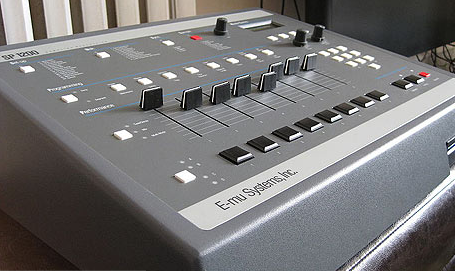
It’s a well known fact that by the late 80’s, the E-mu SP1200 became the premier choice of samplers for commercial and indie hip-hop producers worldwide. Introduced in 1987, The grimy 12-bit sampling resolution and 10 second maximum sample time proved to have it’s limitations but despite that, it became the hallmark, signature sound of old-school hip-hop and house music. The SP-1200 was SO popular that it got reissued and manufactured through 1997. All the major hip-hop producers out of NYC, from Lord Finesse to Marley Marl to Pete Rock used the SP-1200 has their weapon of choice. Below is indie beat maker Surock showcasing a track done on the SP-1200.
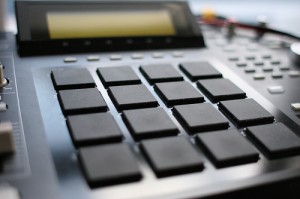
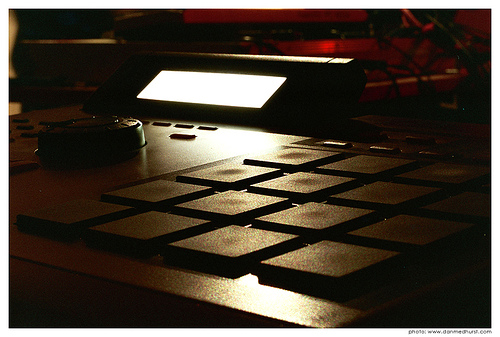
In 1988, Roger Linn (known for the famous Linn Drum (think Prince tracks from Purple Rain), created partnership with Japanese corporation Akai and created what is probably singlehandedly known as the greatest machine made for creating hip-hop music: The Akai MPC Music Production center. Scores of hip-hop legends from DJ Premier to Pete Rock dominated this machine and made it the center of hip hop production. The MPC-60 began a long heritage of MPCs such as 2000, 2000xl, 3000, 2500, 1000, 4000, 5000, 1000 and 500. The MPC is known for its TIGHT timing and swing that is a staple of 90’s hip hop, still incorporating, as a 12-bit sampler, that grimy sound both associated with and loved in, hip hop. Here is a history of the MPC in video format:
As a songwriter, musician, and composer, I grew up playing in R&B bands as a teenager. The drum machine found it’s way into my composition tool box way before an actual computer did. By this time, the same vendors that manufactured hardware samplers, also manufactured drum machines that had internal sounds based on PCM samples of various drum kits. I became, like many, accustomed to programming drum tracks on these machines which have pads just like the MPC. As my studio grew, it wasn’t until about two years ago that I finally got around to incorporating a MPC 1000 into my setup. What I enjoy about using the MPC is not only the availability to load and edit samples for tracks, but I much more enjoy programming drum tracks with pads via using a keyboard.
With the availability of the sampler in mainstream music production, it exploded in the area of hip-hop, with artists “crate diggin” for the most obscure tracks on vinyl to create the next banger. It turns out that the most sought after, used (and frankly exploited) tracks came from one artist, the hardest working man in show business: James Brown. To get an idea of just how much of his music was sampled in hip-hop (and beyond) check this link out. While the use of JB’s music greater exposed him to even music fans (young and old), there’s always been the issue of legality in sampling his tracks and tracks of the artists he produced. I’ll touch on legality issues in a subsequent part of this post. Suffice it say, I’ve heard some of the most ingenious and creative results of sampling Mr. Brown over time, some being the hottest tracks ever created. There is no question that James Brown and his music provided the fuel to propel hip-hop forward in many ways. Once again, barring the legal issues, the skill and creativity of hip-hop producers in the sampling of JB’s tracks, paid him great homage (and still do).
That’s it for now. In Part 2, I’ll give my thoughts on sampling vs interpolation and touch briefly (as if it hasn’t been touched on enough), the legalities of sampling.
Samples everywhere, User made, professionally sold. I feel a big blog post coming on. A few more sections of research to do. In the mean time, check out this article from Music Radar.
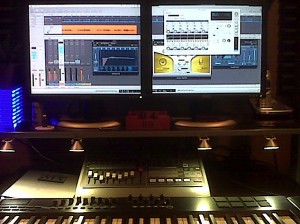
Me, I’m going back to the music production computer next to me…I just loaded some samples into Logic’s EXS24
Hope all is well with u. Sitting in The Lab this rainy Sunday evening, thinking about the various projects I’m working on, and testing out a new WP plugin called Twitter Tools (which will hopefully work to auto-post this, since Bird Feeder was not updated to work with Twitter’s recent OAuth configuration).
AfterSix Productions: We’re close, very close after *years* of working on this project. Currently looking at a new male vocalist to complete this duet I wrote, then it’s off to mixing and prepping tracks for final master. The next three months are pretty much laid out in our project file. The website is 99% done and looks good. Just need to make final decisions on the mastering facility, distribution, etc.
contempojazzsoulhop: Cross Country Collective. This is the genius of Fave and The Big La. The single “Give To Ya” has been released and well received in the US and abroad. Head nod to both these prolific musicians for allowing me in on this project…stay tuned.
SFTF: Yep, your man…this is my project, various original tracks and songs I’ve been working on, as well as remix projects I’ve been done and will continue to do.
The Nikki Ruth Project: This is the brainchild of another prolific songwriter and producer, Ms Tina E. Clark. Very versed in the music business, she has the Midas Touch with everything she lays her hands on. I’ve been asked to participate on this project and she’s released the first track entitled “Pearl” available on iTunes.
Sphere of Influence: Smooth jazz keyboardist and long time friend, Tim Watson is working on a new release. I had the good fortune of providing the guitar tracks for the title track of this very hot CD. Always a pleasure working with Tim, a musician with a heart of gold.
Various remix projects: The latest I’ve done was a remix for “The Most Impossible Plan”, from The Skatterbrain EP, The Basic Condition Of Life. Headnod to Dan Weatherall for allowing the Twitter community to take part in his latest EP. One thing I’d love to become is a great remixer. Luckily there are plenty contests and projects out there on a regular basis.
I’ve got a new personal project that I plan to launch in 2011. Domain is registered, host in place. Stay tuned.
That’s it for now. Enjoy the evening.
::: oceans of rhythm :::
F!
PS: Big thanks to Gadget Girl for helping me to get Twitter Tools to work.
This a test of Twitter Tools Auto-posting. Had this been a real blog post, you would be instructed to read the blog post as directed by the included instructions. This is only a test….
I trust this post finds you well. I was chatting with fellow podcaster (as we usually do during the week) Darrenkeith about the abundance of new tracks I had gathered throught the week from YouTube. Needless to say I collected enough tracks for two podcasts. After converting the video to audio tracks only, I put them in a folder for later moving to my iTunes library. I also was in the midst of organizing my hard drive folders and external drive contents, trashing a lot of files I didn’t need. Well guess what got trashed accidentally? Nuff said. Fortunately, all the videos I used for the audio are saved to My Favorites in YouTube….I’m just too tired to reconvert them to audio for a new podcast tomorrow, hence the recast. I’ll lean on the reasoning of presenting previous tracks to newer listeners and favorite tracks to older ones….hows that?Tomorrow, it’s back to the conversions.
For the visual, Kaskade, world renowned DJ and dance music producer out of San Francisco, brings us one of his more mellower and very chilled tracks, “Right Dream”.
That’s it…It’s my wish that u enjoy this podcast, it’s always a pleasure to bring it. Be sure to check out my fellow podcast massive in my blogroll. I’m certain you will enjoy what they have to offer.
Hope this post finds you well. The Labor Day weekend, for those of us in the U.S., is upon us. I, for one, am glad that I’m able to get an extra day to chill out before returning back to the office. In that spirit of relaxedness (is that a word?), I bring you the playlist and flow for this podcast.
I just returned this afternoon, from a wedding in N. Carolina that was quite nice. The weather held up perfectly for an outdoor matrimonial event, and the reception was VERY nice as well. I wish the happy couple (whom I’ve known for some time) a long and love-filled marriage.
Today’s track span the genres of nu-jazz, latin-flavored, downtempo, and chillout, with a bit of ambient mixed in. It’s my hope you enjoy it. This edition includes the lead off track, Reel Life by The Cinematic Orchestra (The Evolution II remix). I especially enjoy this track for it’s orchestral elements and the way it invokes visuals of movement via it’s musical composition. After noticing a tweet earlier this week from Honeysugarwater, mentioning Bebel Gilberto’s original tune “Aganju”, I decided to feature the remix this time around. The apex of the podcast brings Ocean Air by dZihan and Kamien. I first heard of them not on the net or elsewhere, but via a musician, songwriter, and producer who lives not too far from me. I was hanging out in his studio, listening to some tracks he had in his “vault” and we got onto the subject of downtempo and chillout. He had asked if I had heard of them and played a track by the name of which I can’t recall, but after hearing it, I was on a hunt to find everything I could by them. They’ve been featured on many Sunday Soundtrack editions since ’07. Rounding out this edition is a very laidback track by a group entitled Bliss. I discovered them on another website when track hunting last year. They often hinge on ambient compositions, but I happened to like most of what I’ve heard thus far. It’s my wish that you do as well. Without further adieu, I present to you the playlist.
All the tracks featured in this edition can be found via Amazon, iTunes, and the various sources offered by discogs.com. For those of you on Twitter, feel free to follow The Sunday Soundtrack. I’d appreciate it.